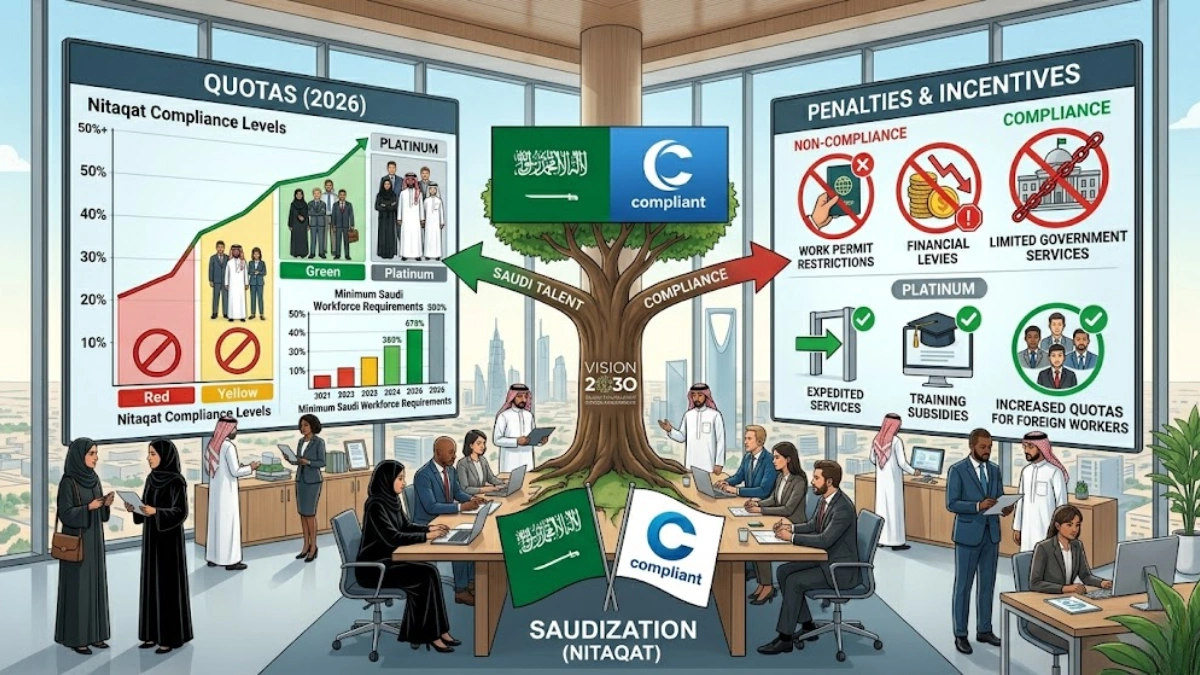
Saudi Arabia’s labor market continues to evolve rapidly in 2026 under Vision 2030, with one of the most influential policies being Saudization (Nitaqat). This system is designed to increase employment opportunities for Saudi nationals in the private sector while ensuring businesses maintain balanced workforce structures.
The program is enforced by the Ministry of Human Resources and Social Development and applies to all private companies operating in Saudi Arabia.
In 2026, Saudization requirements are becoming more dynamic, sector-specific, and closely monitored through digital compliance systems. Businesses that fail to meet quotas risk penalties, restrictions, and even operational limitations.
What is Saudization (Nitaqat)?
Saudization, also known as the Nitaqat system, is a classification-based employment policy that requires private companies to hire a specific percentage of Saudi nationals depending on:
- Industry type
- Company size
- Number of employees
- Job roles and skill levels
Companies are categorized into compliance bands that directly impact their ability to hire foreign workers and access government services.
Nitaqat Classification System (2026 Update)
The Nitaqat system divides companies into four major categories based on Saudization performance:
1. Platinum Category
- Highest level of compliance
- Strong Saudization ratio
- Priority access to labor services
- Faster visa approvals
2. Green Category (High, Medium, Low)
- Meets required Saudization quotas
- Normal access to recruitment and visa services
- Stable business operations
3. Yellow Category
- Below required Saudization levels
- Limited ability to hire expatriates
- Restricted visa renewals
4. Red Category
- Lowest compliance level
- Severe restrictions on hiring
- No new foreign recruitment permits
- Risk of penalties and audits
Nitaqat Category Comparison Table
| Category | Compliance Level | Hiring Rights | Government Services |
|---|---|---|---|
| Platinum | Excellent | Full access | Priority processing |
| Green | Compliant | Normal hiring allowed | Standard services |
| Yellow | Low compliance | Restricted hiring | Limited services |
| Red | Non-compliant | Hiring blocked | Severe restrictions |
Saudization Quotas in 2026
In 2026, Saudization quotas are more flexible but also more strictly enforced through real-time monitoring systems. Quotas vary depending on sector and company size.
General Estimated Quotas
| Company Size | Saudization Requirement |
|---|---|
| Large enterprises | 35% – 75% Saudi workforce |
| Medium companies | 20% – 45% Saudi workforce |
| Small businesses | 10% – 30% Saudi workforce |
These percentages are adjusted based on:
- Industry sensitivity
- Regional labor availability
- Strategic national goals
Sector-Wise Saudization Pressure (2026)
| Industry | Saudization Level Required | Enforcement Strength |
|---|---|---|
| Retail & Wholesale | High | Strict |
| Banking & Finance | Very High | Very Strict |
| Healthcare | High | Strict |
| Hospitality & Tourism | High | Strict |
| Construction | Medium | Moderate |
| IT & Technology | Medium-High | Increasing |
Benefits of High Saudization Compliance
Companies that meet or exceed Saudization targets enjoy multiple advantages:
- Easier work visa approvals for expatriates
- Faster processing of labor services
- Access to premium Nitaqat categories
- Reduced risk of inspections and penalties
- Stronger corporate reputation in Saudi market
High compliance also improves eligibility for government contracts and partnerships.
Penalties for Non-Compliance (2026)
Failure to meet Saudization quotas leads to strict enforcement actions:
1. Hiring Restrictions
- Blocked access to new foreign worker visas
- Limited ability to renew expatriate contracts
2. Financial Penalties
- Fines based on violation severity
- Repeated violations increase penalties
3. Category Downgrade
- Movement from Green to Yellow or Red category
- Loss of labor privileges
4. Service Limitations
- Delayed government approvals
- Reduced access to labor portals
5. Operational Impact
- Workforce shortages
- Project delays
- Increased compliance audits
Penalties Overview Table
| Violation Type | Consequence | Severity |
|---|---|---|
| Low Saudization ratio | Category downgrade | Medium |
| Hiring violations | Visa restrictions | High |
| Repeated non-compliance | Heavy fines | Very High |
| Red category status | Hiring freeze | Critical |
How Businesses Can Improve Saudization Compliance
To maintain a strong Nitaqat rating, companies must adopt structured workforce planning strategies.
1. Strategic Hiring of Saudi Nationals
Focus on hiring Saudis in roles such as:
- Administration
- Sales and customer service
- HR and finance
- Management support roles
2. Workforce Planning
Maintain a balanced ratio between Saudi and expatriate employees based on legal quotas.
3. Training & Development
Invest in upskilling Saudi employees to improve retention and productivity.
4. Regular Compliance Monitoring
Check Nitaqat status frequently to avoid sudden downgrades.
5. Use Official Platforms
Recruit through government-approved systems and maintain accurate records.
Compliance Strategy Table
| Strategy | Purpose | Business Benefit |
|---|---|---|
| Saudi hiring focus | Increase quota compliance | Avoid penalties |
| Training programs | Improve retention | Skilled workforce |
| Workforce audits | Monitor compliance | Prevent downgrade |
| Digital hiring systems | Legal compliance | Faster approvals |
Common Mistakes by Businesses
Many companies face penalties due to avoidable errors:
- Ignoring Saudization requirements during hiring
- Delaying recruitment of Saudi nationals
- Incorrect employee classification
- Not updating workforce data
- Over-reliance on expatriate workers
These mistakes often lead to category downgrades and hiring restrictions.
Impact on Foreign Workers
Saudization does not eliminate foreign employment but regulates it more strictly. For expatriates, this means:
- Increased competition in entry-level roles
- Preference for skilled and technical jobs
- More stable employment in compliant companies
- Possible job mobility restrictions in certain sectors
Skilled workers in engineering, healthcare, and IT still remain in strong demand.
Future of Saudization in Saudi Arabia
Saudization is expected to become more advanced and automated in the coming years:
- AI-based compliance monitoring
- Real-time workforce tracking
- Sector-specific dynamic quotas
- Stronger enforcement for private sector companies
- Integration with national employment platforms
These developments aim to create a sustainable and balanced labor market aligned with Vision 2030.
FAQs
1. What is Saudization (Nitaqat)?
It is a government policy requiring private companies to employ a minimum percentage of Saudi nationals.
2. Who enforces Saudization rules?
The Ministry of Human Resources and Social Development (MHRSD).
3. What happens if a company is in the Red category?
It faces hiring freezes, visa restrictions, and possible fines.
4. Are Saudization quotas the same for all companies?
No, they vary by company size and industry.
5. Can companies recover from a downgrade?
Yes, by hiring more Saudi nationals and improving compliance levels.
6. Which sectors have the strictest Saudization rules?
Banking, retail, healthcare, and hospitality sectors.
Final Thoughts
Saudization (Nitaqat) in 2026 is a highly structured and strictly monitored system that plays a crucial role in shaping business operations in Saudi Arabia. Companies that proactively manage compliance benefit from smoother operations, better government access, and reduced legal risk.
On the other hand, non-compliance can lead to serious penalties, hiring restrictions, and long-term operational challenges. For businesses operating in Saudi Arabia, maintaining strong Saudization compliance is not just a legal requirement it is a strategic necessity for long-term success.