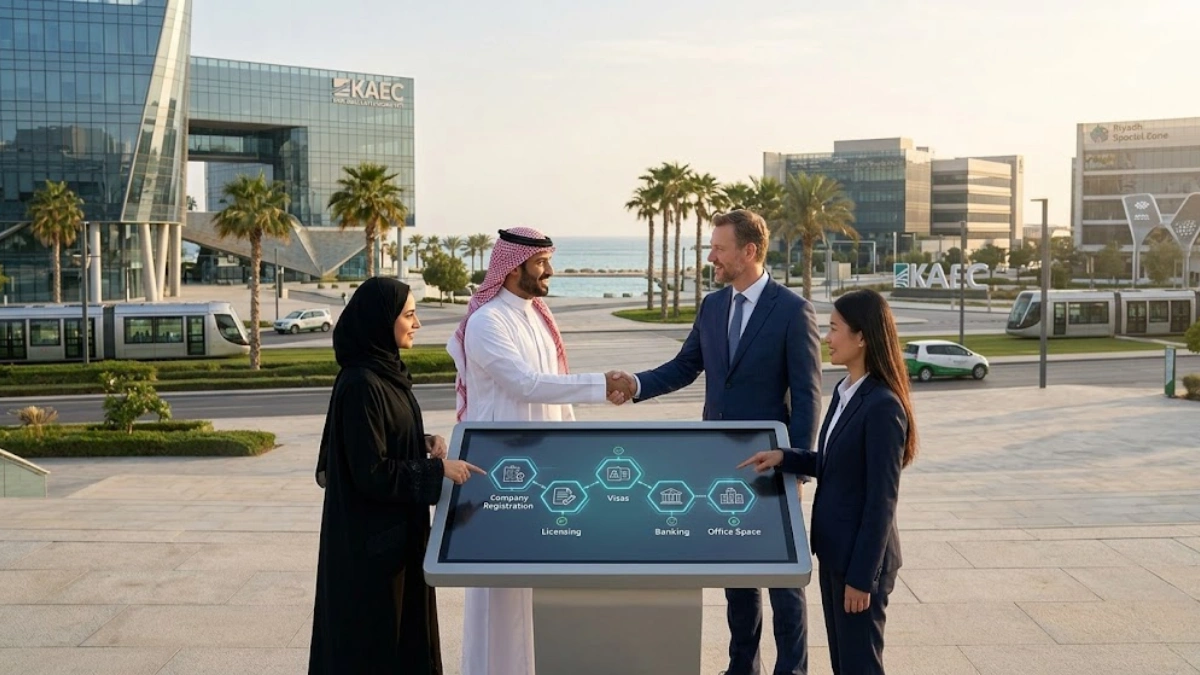
Saudi Arabia has rapidly evolved into one of the most attractive investment destinations in the world, especially with the rise of special economic zones (SEZs) and free-zone-style developments such as KAEC and the Riyadh Special Economic Zone. These zones are designed to attract foreign investors by offering tax incentives, simplified regulations, and world-class infrastructure.
In this guide, you will learn how to set up a free zone company in Saudi Arabia step by step, including requirements, benefits, costs, timelines, and legal structure options.
What Is a Free Zone Company in Saudi Arabia?
A free zone company in Saudi Arabia refers to a business established within a special economic zone (SEZ) that offers regulatory and financial incentives compared to mainland operations.
Unlike traditional free zones in other countries, Saudi Arabia uses SEZs such as:
- KAEC (King Abdullah Economic City)
- Riyadh Integrated Special Logistics Zone
- Jazan, Ras Al Khair, and other strategic zones
These zones are regulated under Saudi investment authorities and aligned with Vision 2030. Most approvals are linked with the Ministry of Investment of Saudi Arabia and SEZ authorities.
Why Choose a Free Zone Company in Saudi Arabia?
Setting up in a free zone offers several advantages:
- 100% foreign ownership in most cases
- Tax incentives or reduced tax obligations
- Customs duty exemptions (on eligible goods)
- Simplified import/export processes
- Fast-track licensing approvals
- Modern infrastructure and logistics access
These benefits make SEZs especially attractive for logistics, manufacturing, and international trading companies.
Major Free Zones in Saudi Arabia
KAEC (King Abdullah Economic City)
KAEC is one of the most developed economic cities in Saudi Arabia.
Key industries:
- Logistics
- Manufacturing
- Port operations
- Real estate development
Advantages:
- Direct access to King Abdullah Port
- Integrated industrial ecosystem
- Foreign investment-friendly policies
Riyadh Integrated Special Logistics Zone
This zone focuses on global supply chain and logistics companies.
Key features:
- Close to Riyadh airport
- Designed for re-export businesses
- Fast customs clearance
Ideal for:
- E-commerce companies
- Aviation logistics
- Global distribution hubs
Other Special Zones
Saudi Arabia also includes:
- Jazan Economic City (industrial & energy)
- Ras Al Khair (mining & heavy industry)
- NEOM zones (future innovation hub)
Step-by-Step Process to Set Up a Free Zone Company
Step 1: Choose Your Free Zone Location
Your first decision is selecting the right SEZ based on business activity:
| Zone | Best For |
|---|---|
| KAEC | Manufacturing, logistics |
| Riyadh SEZ | Trade, e-commerce |
| Jazan | Energy, industry |
| NEOM | Tech, innovation |
Choosing the correct zone affects licensing approvals and operational benefits.
Step 2: Define Business Activity
You must clearly define your business activity, such as:
- Import/export trading
- Warehousing
- Manufacturing
- E-commerce operations
- Logistics services
Each activity has different licensing rules and capital requirements.
Step 3: Prepare Required Documents
To apply for a free zone company, you typically need:
- Passport copies of shareholders
- Business plan
- Company profile (if foreign parent company exists)
- Financial statements (if applicable)
- Proof of address
- Application form
All foreign documents may require legalization and translation into Arabic.
Step 4: Apply Through Free Zone Authority
Each free zone has its own authority, but approvals are coordinated with Saudi investment regulators.
Applications include:
- Company structure details
- Capital investment information
- Activity classification
- Ownership details
Final approval is often supported by the Saudi Business Center system.
Step 5: Obtain Investment Approval
Foreign investors usually require approval from:
- Investment authority (MISA)
- Free zone governing body
- Relevant sector regulators
Once approved, you receive permission to proceed with incorporation.
Step 6: Register Company and Obtain License
After approval, you must:
- Register company legally
- Obtain free zone license
- Sign lease agreement for office/warehouse space
- Register business address
This step officially activates your company in the SEZ.
Step 7: Open Corporate Bank Account
To operate, you need a Saudi corporate bank account.
Banks typically require:
- Free zone license
- Shareholder documents
- Business plan
- Company incorporation certificate
Step 8: Tax and Compliance Registration
Even in free zones, businesses must comply with Saudi regulations, including registration with:
- Zakat, Tax and Customs Authority
- VAT registration (if applicable)
- Customs declarations for imports/exports
Step 9: Employee and Visa Setup
If hiring employees, you must register with:
- General Organization for Social Insurance
- Labor ministry systems
- Immigration authorities for visas
Cost of Setting Up a Free Zone Company
Costs vary depending on the zone and business activity.
| Expense Type | Estimated Cost |
|---|---|
| License fee | Medium |
| Office/warehouse lease | Medium–high |
| Registration fee | Low–medium |
| Legal & consultancy | Optional |
KAEC and Riyadh SEZ may have premium infrastructure costs compared to smaller zones.
Timeline for Free Zone Company Setup
| Stage | Time Required |
|---|---|
| Approval process | 5–15 days |
| Company registration | 3–7 days |
| Licensing | 2–5 days |
| Bank account setup | 3–10 days |
Total estimated time: 10–30 working days
Advantages vs Mainland Company
| Factor | Free Zone Company | Mainland Company |
|---|---|---|
| Ownership | 100% foreign (usually) | Sometimes shared |
| Tax benefits | Possible incentives | Standard tax rules |
| Market access | Export-focused | Full local market |
| Setup speed | Faster | Moderate |
Common Mistakes to Avoid
- Choosing wrong zone for your industry
- Incomplete document attestation
- Ignoring customs rules for imports
- Weak business plan submission
- Not understanding VAT obligations
Future of Free Zones in Saudi Arabia
Saudi Arabia is expanding SEZs as part of Vision 2030 to become a global logistics and investment hub.
Future trends include:
- More digital licensing systems
- Expanded tax incentives
- Integration with NEOM innovation zones
- Faster customs clearance systems
- Increased foreign ownership flexibility
FAQs
1. What is a free zone company in Saudi Arabia?
It is a business operating in a special economic zone with incentives like tax benefits and simplified regulations.
2. Can foreigners fully own free zone companies?
Yes, most SEZs allow 100% foreign ownership.
3. Is KAEC a free zone?
KAEC functions as a special economic city with free-zone-like benefits for investors.
4. How long does setup take?
Typically 10–30 working days depending on approvals.
5. Do free zone companies pay tax?
They may receive incentives, but VAT and other obligations still apply in many cases.
6. Which is the best free zone in Saudi Arabia?
KAEC is best for logistics and manufacturing, while Riyadh SEZ is ideal for trade and distribution.
Final Thoughts
Setting up a free zone company in Saudi Arabia in 2026 is one of the most strategic moves for global investors. With strong government support, modern infrastructure, and Vision 2030 reforms, zones like KAEC and Riyadh SEZ provide powerful opportunities for international business growth.
With proper documentation and the right zone selection, investors can establish operations quickly and benefit from one of the fastest-growing economies in the world.