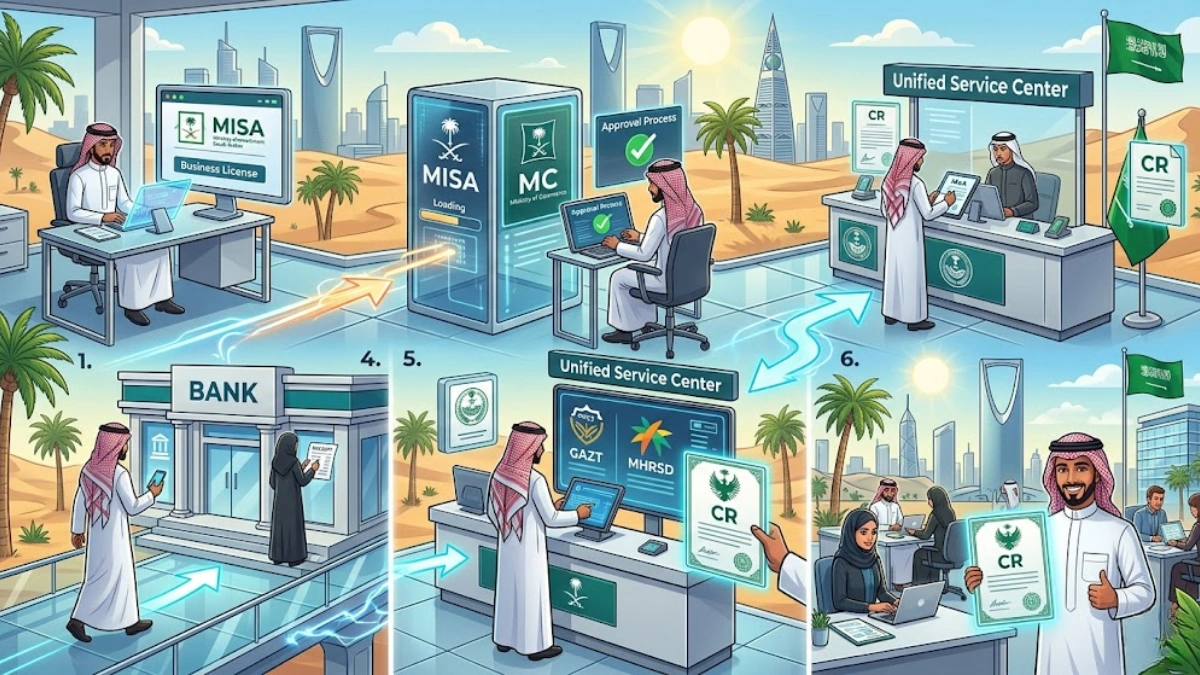
Saudi Arabia remains one of the most attractive business destinations in 2026 due to its Vision 2030 reforms, rapid digital transformation, and strong government support for foreign investors. The company registration process has become faster, more transparent, and highly digitalized but it still requires careful compliance with legal and regulatory steps.
This guide explains how to register a company in Saudi Arabia in 2026 step by step, including legal requirements, costs overview, timelines, and compliance obligations.
Why Start a Company in Saudi Arabia in 2026?
Saudi Arabia continues to expand opportunities in non-oil sectors such as technology, tourism, logistics, construction, and e-commerce.
Key benefits include:
- 100% foreign ownership in many sectors
- Simplified online registration systems
- Strong infrastructure and tax reforms
- Access to GCC and global trade routes
- Government-backed investment incentives
Most business approvals are managed through the Ministry of Investment of Saudi Arabia, while company formation is handled via the Saudi Business Center.
Step 1: Choose Your Business Activity and Legal Structure
Before registration, clearly define your business activity.
Common legal structures in 2026:
| Structure Type | Best For | Ownership |
|---|---|---|
| LLC (Limited Liability Company) | SMEs & startups | Local or foreign |
| Branch Office | International companies | 100% parent company |
| Joint Stock Company (JSC) | Large enterprises | Multiple shareholders |
| Sole Proprietorship | Small local businesses | Saudi/GCC nationals |
Your chosen activity (IT, consulting, trading, construction, etc.) determines licensing requirements and approvals.
Step 2: Reserve Your Company Name
Your company name must:
- Be unique and not already registered
- Follow Arabic naming regulations
- Avoid religious or political terms
- Match business activity
Name approval checklist:
| Requirement | Status |
|---|---|
| Arabic name availability | Mandatory |
| English translation | Recommended |
| Activity relevance | Required |
| Trademark conflict check | Required |
Approval is usually completed within 24–48 hours via digital systems.
Step 3: Obtain Investment License (Foreign Investors Only)
Foreign investors must apply for an investment license from MISA.
Required documents:
| Document | Notes |
|---|---|
| Passport copies | All shareholders |
| Business plan | Detailed operations overview |
| Financial statements | For existing companies |
| Parent company certificate | For branch setup |
The authority evaluates:
- Economic contribution
- Job creation potential
- Compliance with Saudi regulations
Once approved, you receive your investment license to proceed.
Step 4: Draft and Notarize Articles of Association (AOA)
The Articles of Association define your company structure.
It includes:
- Shareholding distribution
- Capital investment
- Management authority
- Business activities
AOA process overview:
| Step | Description |
|---|---|
| Drafting | Prepare legal structure |
| Review | Government validation |
| Notarization | Digital or physical approval |
Most notarization in 2026 is completed online for faster processing.
Step 5: Register Commercial Registration (CR)
The Commercial Registration (CR) is your company’s legal identity in Saudi Arabia.
You apply through the Saudi Business Center platform.
Required documents:
- Investment license (if applicable)
- Notarized AOA
- Registered business address
- Shareholder information
Once approved, you receive a CR number that allows legal operation.
Step 6: Chamber of Commerce Registration
After obtaining CR, you must register with the Chamber of Commerce.
Benefits include:
- Legal recognition in local trade
- Eligibility for government contracts
- Business credibility enhancement
| Requirement | Purpose |
|---|---|
| CR Certificate | Verification |
| Company seal | Authorization |
| Membership fee | Activation |
Step 7: Open a Corporate Bank Account
A corporate bank account is mandatory for operations.
Banks typically require:
- CR certificate
- Shareholder identification
- Business activity details
- Company seal
Some banks may also request financial projections or compliance documents.
Step 8: Tax and Zakat Registration
All businesses must register with the Zakat, Tax and Customs Authority.
Tax obligations include:
| Tax Type | Applicable To |
|---|---|
| VAT (15%) | Revenue above threshold |
| Corporate Tax | Foreign-owned shares |
| Zakat | Saudi/GCC-owned entities |
Proper classification is essential to avoid penalties.
Step 9: Register Employees with GOSI
If you hire employees, registration with the General Organization for Social Insurance is required.
GOSI covers:
- Employee pensions
- Workplace injury insurance
- Social protection programs
| Contribution Type | Paid By |
|---|---|
| Employer contribution | Company |
| Employee contribution | Salary deduction |
Step 10: Visa and Work Permit Processing
Once your company is active, you can sponsor:
- Investor visas
- Employee work permits (Iqama)
- Family dependent visas
The process is linked with labor and immigration systems and depends on your company’s classification.
Estimated Company Registration Timeline (2026)
| Stage | Duration |
|---|---|
| Name reservation | 1–2 days |
| Investment license | 5–12 days |
| AOA notarization | 1–3 days |
| CR issuance | 2–5 days |
| Bank account setup | 3–10 days |
| Full setup completion | 10–25 days |
Cost Overview (Approximate)
| Item | Estimated Cost |
|---|---|
| Name reservation | Low fee |
| Investment license | Medium fee |
| CR registration | Medium fee |
| Chamber membership | Low to medium |
| Legal & consulting | Optional (varies) |
Actual costs depend on company type, sector, and ownership structure.
Compliance Requirements After Registration
To maintain compliance in 2026, businesses must:
- File annual financial statements
- Renew CR and licenses
- Submit VAT returns (if applicable)
- Maintain accounting records
- Follow Saudization (Nitaqat) rules
Non-compliance may result in fines or license suspension.
Common Mistakes to Avoid
- Choosing incorrect business activity classification
- Submitting incomplete documentation
- Ignoring tax registration deadlines
- Delaying bank account setup
- Not planning Saudization requirements
FAQs
1. Can foreigners fully own a company in Saudi Arabia in 2026?
Yes, in many sectors 100% foreign ownership is allowed after approval from MISA.
2. How long does it take to register a company?
Typically 10–25 working days depending on documentation and approvals.
3. Is physical office space required?
In most cases, a registered business address is required, but virtual offices may be allowed for some activities.
4. Do I need a local partner?
Not always. Many sectors allow full foreign ownership.
5. What is the most common company type?
The Limited Liability Company (LLC) is the most widely used structure.
6. Is Saudi Arabia business-friendly in 2026?
Yes, due to digital systems, simplified licensing, and Vision 2030 reforms.
Final Thoughts
Registering a company in Saudi Arabia in 2026 is significantly faster and more efficient than in previous years. With platforms like MISA and the Saudi Business Center, most steps are now digital. However, proper documentation, correct classification, and compliance with tax and labor regulations remain essential.
Entrepreneurs who prepare well can establish a fully operational business in just a few weeks and tap into one of the fastest-growing economies in the world.