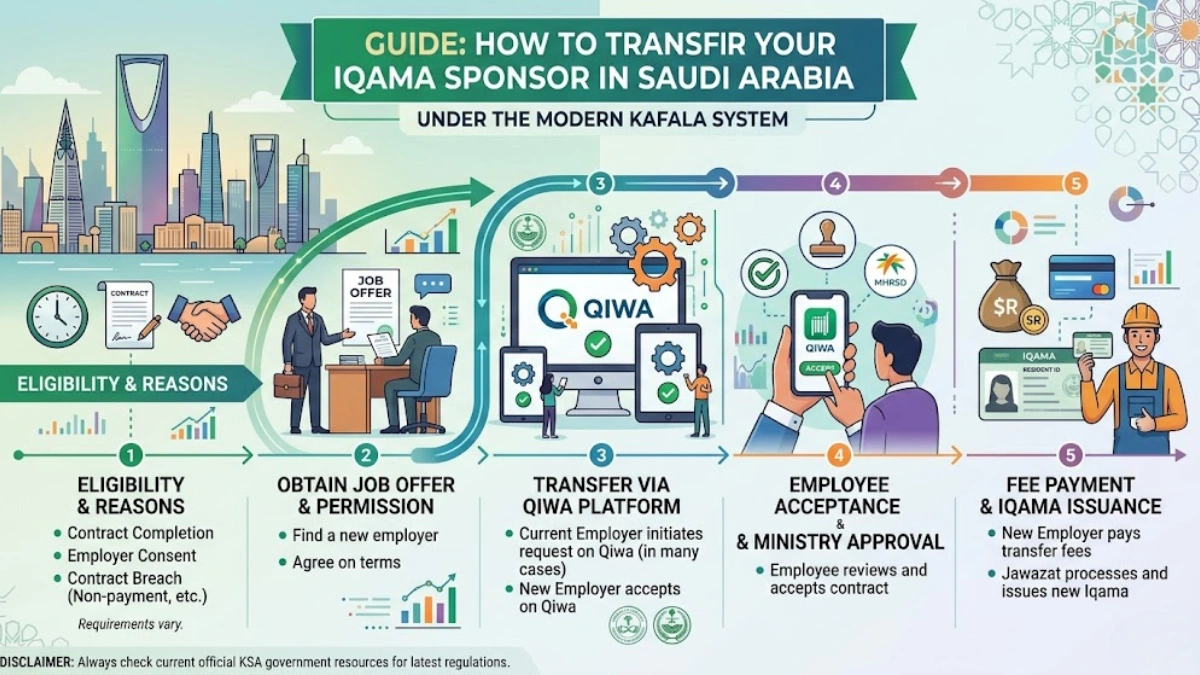
Changing your iqama sponsor in Saudi Arabia is an important legal process under the sponsorship framework known as the Kafala system. This system connects foreign workers’ legal residency (iqama) to their employer or sponsor, meaning any job change usually requires an official transfer of sponsorship.
In recent years, major reforms by the Saudi government and the Ministry of Human Resources and Social Development have made the process more flexible, allowing many workers to transfer jobs without needing their current employer’s approval in specific cases.
This guide explains how iqama transfer works, eligibility rules, step-by-step procedures, fees, and common FAQs.
What is the Kafala System in Saudi Arabia?
The Kafala system is a sponsorship-based labor structure where:
- A foreign worker is tied to a Saudi employer (kafeel)
- The employer is responsible for the worker’s visa, iqama, and legal status
- Changing jobs requires formal approval or eligibility conditions
However, Saudi Arabia has been gradually modernizing this system under labor reforms to improve worker mobility and rights.
When Can You Transfer Your Iqama Sponsor?
You may be eligible for iqama transfer in the following cases:
1. Contract Expiry
If your employment contract has ended, you can transfer sponsorship freely.
2. Employer Approval
Your current sponsor agrees to release you.
3. Employer Violations
If the employer:
- Does not pay salary for 3 months
- Violates contract terms
- Fails to renew iqama
4. Nitaqat Red Category
If your company is in a low compliance category, you may transfer without approval.
5. Mutual Agreement
Both old and new employers agree to transfer via the Qiwa platform.
Step-by-Step Process to Transfer Iqama Sponsor
The process is mainly completed through the Qiwa platform or Absher systems.
Step 1: Find a New Employer
You must secure a job offer from a new Saudi employer willing to sponsor you.
Step 2: Employment Contract Signing
A new digital contract is created and signed via the Qiwa system.
Step 3: Transfer Request Submission
The new employer submits a sponsorship transfer request.
Step 4: Approval Period
- Old employer has a limited response time (usually 7–14 days depending on case)
- If no response in eligible cases, transfer may auto-approve
Step 5: Pay Transfer Fees
Fees are usually paid by the new employer.
Step 6: Update Iqama Records
Once approved, your iqama is updated under the new sponsor.
Required Documents for Iqama Transfer
| Document | Requirement |
|---|---|
| Valid Iqama | Must not be expired |
| Passport copy | Clear scanned copy |
| New job contract | Signed via Qiwa |
| Transfer request form | Submitted online |
| Employer approval | If applicable |
| Fingerprint registration | Must be updated |
Iqama Transfer Fees (2026 Updated Estimate)
| Type of Transfer | Fee (SAR) | Paid By |
|---|---|---|
| First transfer | 2,000 SAR | Employer |
| Second transfer | 4,000 SAR | Employer |
| Third transfer | 6,000 SAR | Employer |
| Additional transfers | 6,000+ SAR | Employer |
Note: Fees may vary based on company category and policy updates.
Online Platforms Used for Transfer
1. Qiwa Platform
Main system for contract and transfer requests.
2. Absher Portal
Used for iqama services and personal records.
3. Muqeem System
Used by companies for employee management.
Rules You Must Know Before Transferring
- You cannot transfer while under legal violation status
- Your iqama must be valid (or in renewal grace period)
- Some professions require approval from regulatory bodies
- Frequent job switching may require higher transfer fees
- Unauthorized work after leaving sponsor is illegal
Common Problems During Iqama Transfer
1. Employer Refusal
Some employers delay approval to avoid losing workers.
2. Expired Iqama
Transfer may be blocked until renewal is completed.
3. Platform Errors
Qiwa system delays can occur during peak periods.
4. Contract Disputes
Salary or benefits disputes may delay approval.
Tips to Make the Transfer Process Easier
- Always ensure your iqama is valid before applying
- Keep salary records and contract copies
- Communicate clearly with both employers
- Check Nitaqat category of your company
- Apply through official platforms only
Benefits of Iqama Transfer Reforms
Saudi Arabia’s labor reforms have improved mobility:
- Easier job switching
- Reduced employer dependency
- Better worker rights protection
- Faster digital processing
- Transparent contract system
These changes support a more flexible labor market aligned with Vision 2030.
FAQs
1. Can I transfer iqama without my employer’s permission?
Yes, in certain cases like contract expiry, unpaid salary, or company violations.
2. How long does iqama transfer take?
Usually 7 to 21 working days depending on approval conditions.
3. Who pays the transfer fee?
Generally, the new employer pays the transfer fee.
4. Can I change jobs immediately after arriving in Saudi Arabia?
No, you must meet eligibility conditions or complete contract terms.
5. Is the Kafala system still active?
Yes, but it has been significantly reformed to allow worker mobility.
Final Thoughts
Transferring your iqama sponsor in Saudi Arabia has become significantly easier due to digital transformation and labor reforms. While the Kafala system still exists in structure, modern regulations now allow more freedom for skilled and semi-skilled workers.
By understanding eligibility rules, using official platforms like Qiwa, and ensuring proper documentation, you can smoothly transition to a new employer without legal issues.